


Accounting Program
Background and Vision
The Accounting Program is a core discipline within the field of Business Administration. Against the backdrop of the booming digital economy and the development of the Guangdong-Hong Kong-Macao Greater Bay Area, every enterprise and organization requires financial managers who possess both professional expertise and proficiency in intelligent technologies. Rooted in the Guangdong-Hong Kong-Macao Greater Bay Area and addressing the needs of small and medium-sized enterprises in manufacturing, modern services and the information technology sector, this Program is dedicated to cultivating well-rounded professionals—with moral, intellectual, physical, aesthetic and labour development—who possess a sense of national pride and social responsibility. Graduates will master AI and big data tools and be capable of working in areas such as intelligent accounting, financial analysis, management accounting and tax management.
Program Objectives
To cultivate graduates who possess a sense of national and social responsibility, good moral character and a strong sense of social responsibility; who are well-rounded in moral, intellectual, physical, aesthetic and labour education; who have a solid foundation in general knowledge and professional accounting theory; who are able to utilize AI and big data tools to analyse and address complex issues such as daily financial accounting, tax filing and business-finance data integration, and can independently carry out core tasks such as comprehensive bookkeeping, financial software operation, and basic data analysis and visualization. Graduates will primarily work in small and medium-sized enterprises within the manufacturing, modern service, and information technology sectors of the Guangdong-Hong Kong-Macao Greater Bay Area, undertaking roles in intelligent accounting, financial analysis, management accounting and tax management, and developing into high-calibre, versatile professionals capable of advancing to positions such as Finance Manager, Financial Analysis Manager or Financial Digitalisation Consultant. Upon graduation, students may pursue careers in the following fields:
● Government agencies and the public sector
● Corporate and institutional finance
● Accounting firms and professional services
Program Highlights
Program Accreditation: This Program is designated as a university-level first-class undergraduate Program (approved in 2024) and is actively pursuing ACBSP international accreditation, enhancing the Program’s quality in line with international standards.


Fig. 1 Faculty members from our department attending the ACBSP accreditation seminar in 2025
Excellence Teaching Staff: We boast a ‘dual-qualified’ teaching team comprising professors, chartered accountants and industry practitioners, with over 20% of staff having studied abroad and more than 30% holding dual qualifications.
Laboratory Practical Training System: The college has established eight specialist laboratories, including a Business-Finance Integration Training Lab, an Intelligent Finance Training Lab, a Finance Shared Services Training Lab, an Audit Big Data Training Lab and a Finance Big Data Training Lab. These are equipped with enterprise-level tools such as Kingdee EAS, a finance shared services platform and audit data analysis software, supporting practical teaching across the entire process from basic accounting to strategic decision-making.

Fig. 2 Training Laboratories
Course Highlights
OBE Outcome-Based Education: Centred on the attainment of students’ final competencies, the curriculum and assessment standards are designed using a backward design approach to ensure graduates possess clearly measurable professional competencies in accounting, financial analysis, tax compliance and the application of intelligent tools.
Digitalisation/AI-Empowered Curriculum: Aligning with the demands of the digital economy, the curriculum integrates topics such as intelligent finance and financial shared services, offering industry-academia collaboration courses including ‘RPA Robotics’, ‘Intelligent Financial Shared Services’, and ‘Financial Big Data Analysis and Decision-Making’.

Fig. 3 Students learning in the practical training laboratory

Fig. 4 Students practising AI-assisted bookkeeping
Deep Integration of Courses and Certifications: Students are encouraged to obtain the Junior Accountant Professional Technical Qualification Certificate, with a pass rate of over 85% for the Junior Accountant examination.
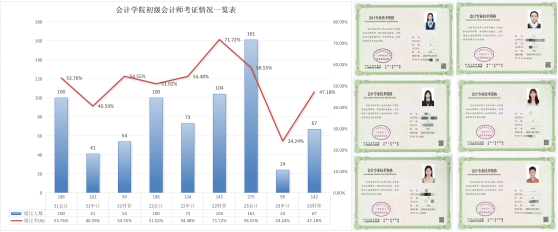
Fig. 5 Student Certification Status
Blended Online and Offline Teaching: All courses utilise the ChaoXing Learning Pass platform to ensure comprehensive coverage of the resource library, with an online usage rate exceeding 95%, supporting a full-process learning experience encompassing pre-class preparation, in-class interaction and post-class consolidation.
Core Courses
Currently, this Program offers two provincial-level first-class courses and over ten university-level first-class courses.
| Course Categories | Representative Courses |
|---|---|
| Core Foundation Courses | Introductory Accounting, Intermediate Financial Accounting, Advanced Financial Accounting, Cost Accounting, Management Accounting, Auditing, Financial Management, Tax Law |
| Industry-Education Integration Courses | RPA Robotics, Intelligent Financial Shared Services |
| Digitalisation/AI-Enabled Courses | Financial Big Data Analysis and Decision-Making, Accounting Information Systems |
Degree Awarded: Bachelor of Management
Employment, Internships and Career Prospects
Graduates may pursue careers in accounting, financial reporting, tax management and internal auditing within various enterprises, public institutions, accounting firms, financial institutions and government finance departments. With the addition of digital and intelligent skills, they are also well-suited for emerging roles such as those in financial shared service centers and as intelligent financial analysts.
Government and Public Sector Finance: Accounting, budget implementation, financial reporting, tax management and internal audit within government finance departments.
Corporate and Public Sector Finance: Accounting, financial reporting, cost control, tax management, internal audit and financial analysis in various enterprises.
Professional services sector (including accounting firms): Audit, tax consultancy, financial due diligence, management consultancy and internal control services.
Financial Institutions: Financial accounting, tax management, internal audit and risk control in banks, securities firms, insurance companies and similar institutions.
Digital and Smart Emerging Finance Track (expandable with additional skills): Finance Shared Service Centers (e.g. Accounts Payable/Receivable Specialists, General Ledger Specialists), Intelligent Financial Analysts, Financial Systems Operations and Maintenance, Financial Data Analysts, RPA (Robotic Process Automation) Specialists, etc.
Industry-Academia Collaboration: Internships and Employment: The Program has signed internship agreements with numerous enterprises to facilitate high-quality internships and employment opportunities for students.

Fig. 6 Signed Internship Training Bases
Employment Rate: Over the past three years, the overall employment rate for graduates has consistently exceeded 94%.